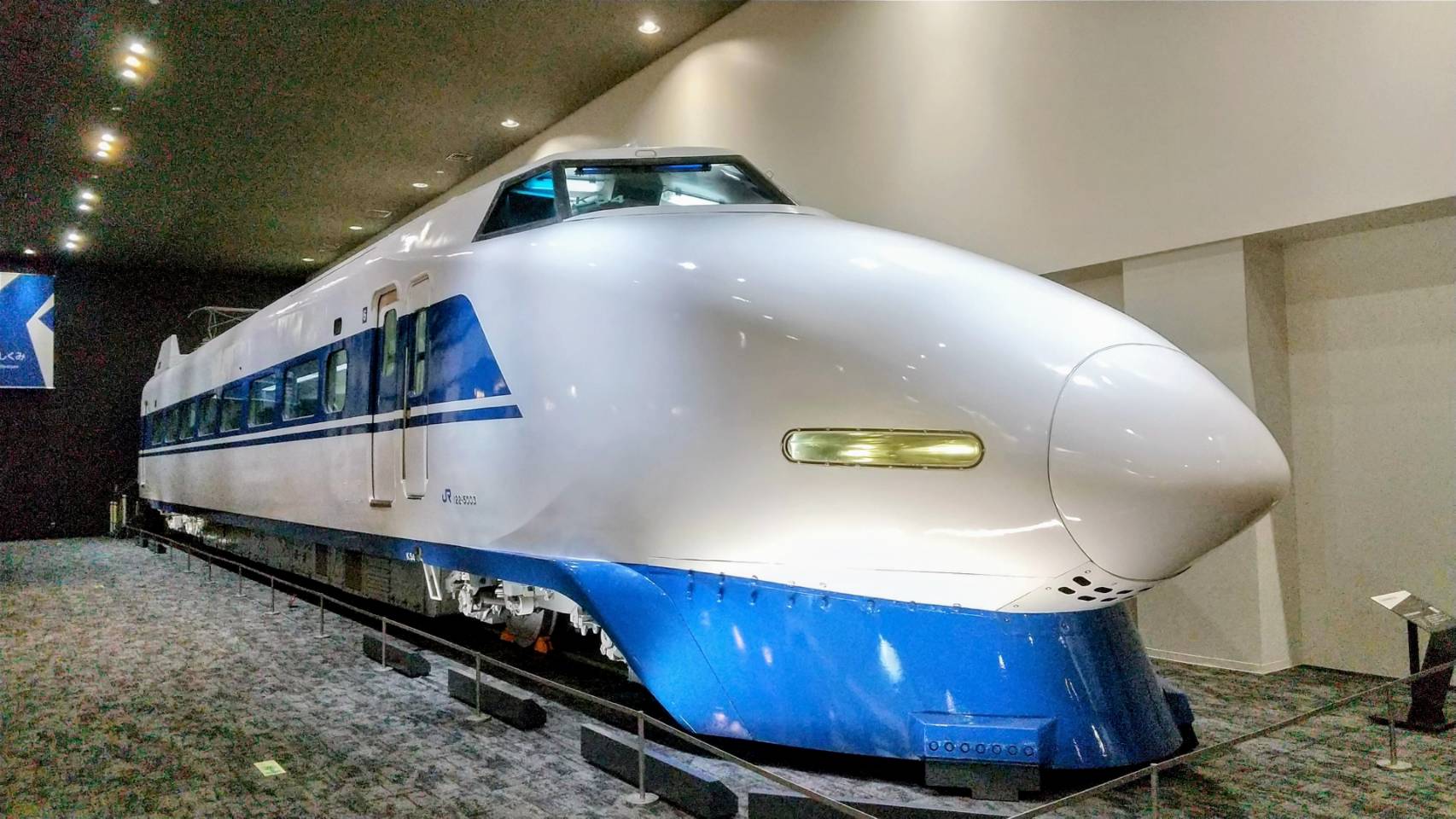
You know the Shinkansen is fast. You know it is punctual. But to treat this engineering marvel as just “transportation” is a missed opportunity. The Tokaido Shinkansen, connecting Tokyo, Kyoto, and Osaka, is a moving museum of Japanese history, obsession, and technology.
As someone who has circumnavigated Japan three times and studies the logic behind travel, I want to share 11 secrets that will change the way you see your next ride.
- 1. The “Mount Fuji” Seat Strategy
- 2. The Mystery of the “Concrete” Ice Cream
- 3. Why “Hope” is Faster than “Light”
- 4. The “Hi-Lite” Design Origin
- 5. The 7-Minute Miracle at Tokyo Station
- 6. The Last Days of “Dr. Yellow” & The Invisible Successors
- 7. Threading the Needle: The “Tokaido Megalopolis” & Tilting Tech
- 8. The Battle Against Snow (Sprinklers)
- 9. The Chime Tells You Who Owns the Train
- 10. The Unbroken Record: Zero Fatal Accidents
- 11. The Future is Floating (Maglev)
1. The “Mount Fuji” Seat Strategy
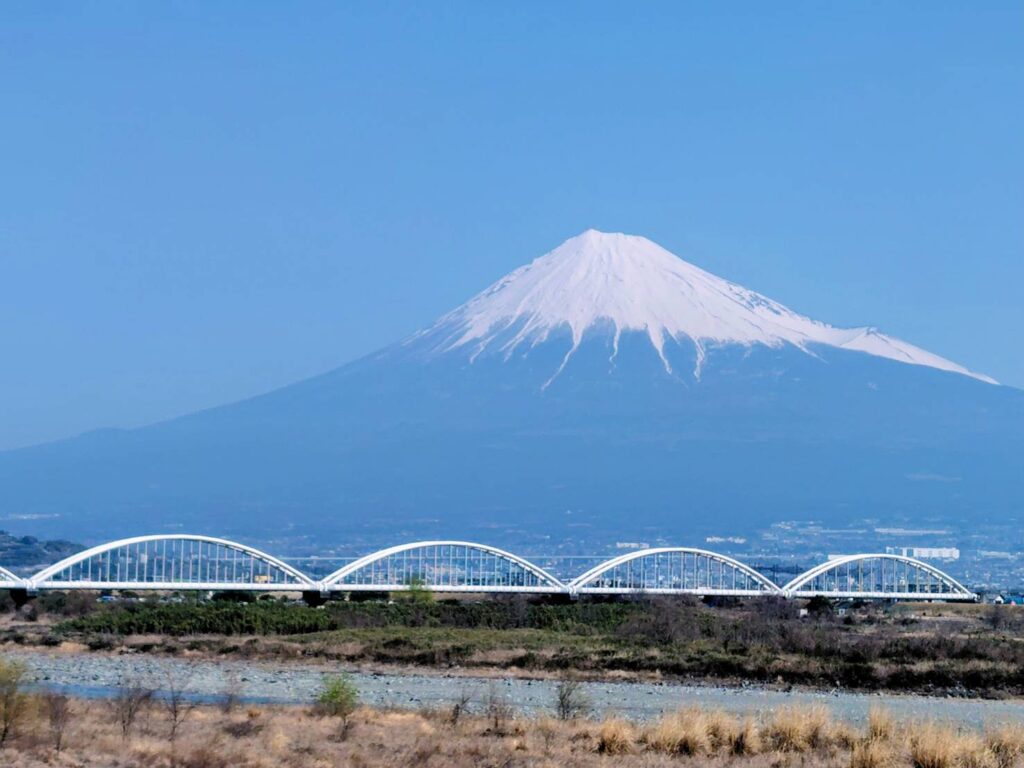
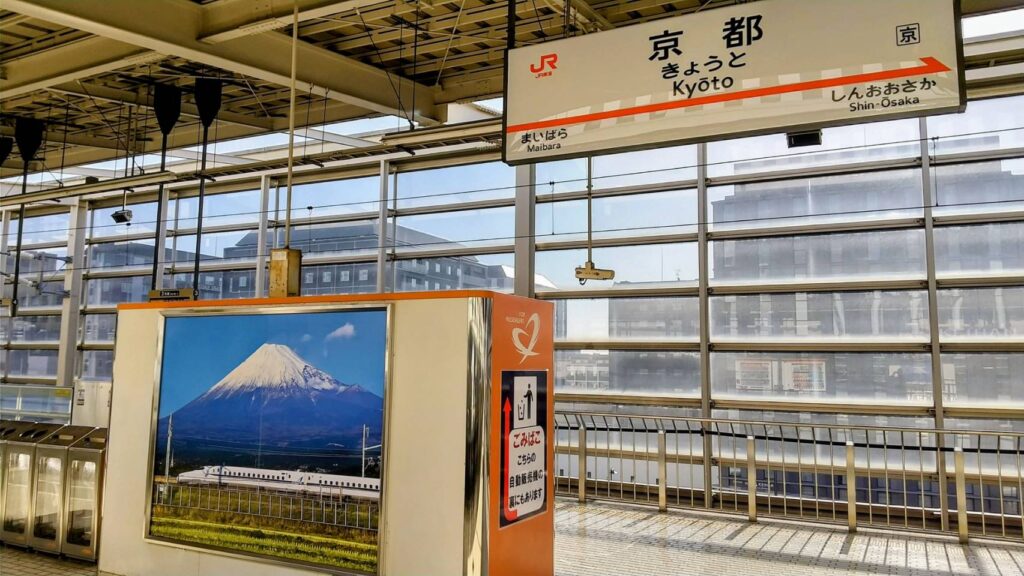
The most common regret travelers have is missing Mount Fuji. The mountain is elusive, but your choice of seat should not be. On the Tokaido Shinkansen, the “E” seat (or “D” seat in the Green Car) is your window to the icon. These are the window seats on the right side when traveling from Tokyo to Kyoto. If you sit on the left, you will see only retaining walls and factories. Remember: “E” stands for “Excellent View.”
2. The Mystery of the “Concrete” Ice Cream
If you see a passenger struggling to stick a spoon into a cup of vanilla ice cream, do not be alarmed. They are battling the “Shinkansen Sugoi-Katai Ice” (The Shinkansen’s Super Hard Ice Cream). Sold on board (via mobile order in Green Cars or vending machines on platforms), this ice cream is kept at a lower temperature than usual to last through long journeys. It is rock solid. The “Pro” way to eat it? Buy a hot coffee simultaneously, pour a little over the ice cream, and enjoy a makeshift affogato while watching the scenery blur by.
3. Why “Hope” is Faster than “Light”
Have you noticed the names of the trains? Nozomi, Hikari, and Kodama. Historically, these names represent a poetic hierarchy. “Kodama” means Echo (sound). “Hikari” means Light. In physics, light is faster than sound. But the fastest train is “Nozomi,” which means Hope. Why? because in the Japanese mindset, “Hope travels faster than Light.” It is a beautiful touch of philosophy in a high-tech machine.
4. The “Hi-Lite” Design Origin
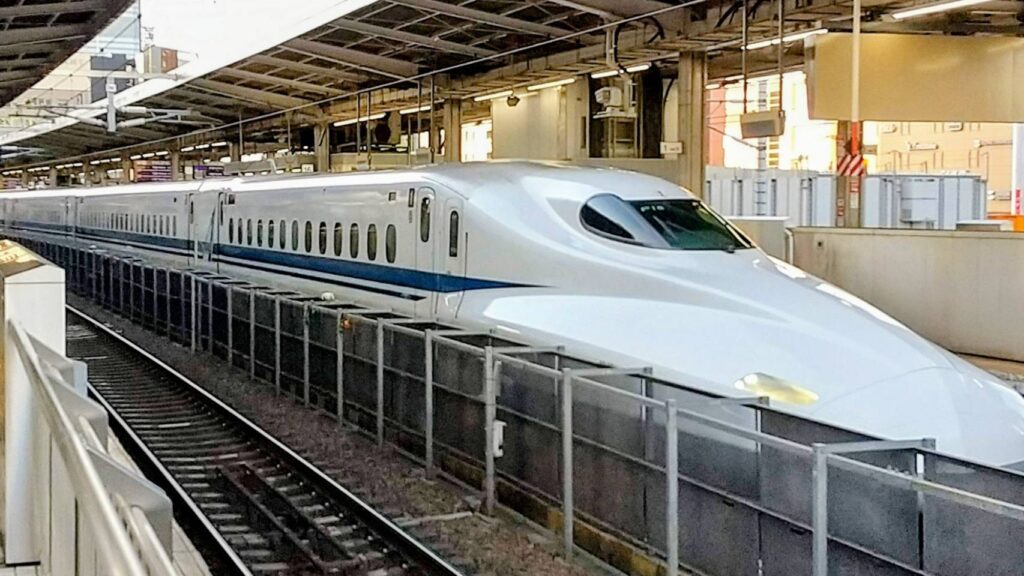
The Shinkansen’s iconic blue and white body is recognized worldwide. You might think this was designed by a fancy agency, but the truth is smokier. Legend has it that when the original engineers were debating the color scheme in the 1960s, the President of the national railways looked at the pack of cigarettes on his desk. It was a brand called “Hi-Lite,”which featured a crisp blue and white design. He decided right there: “Let’s go with this.” The symbol of Japan’s modernization was inspired by a tobacco pack.
5. The 7-Minute Miracle at Tokyo Station
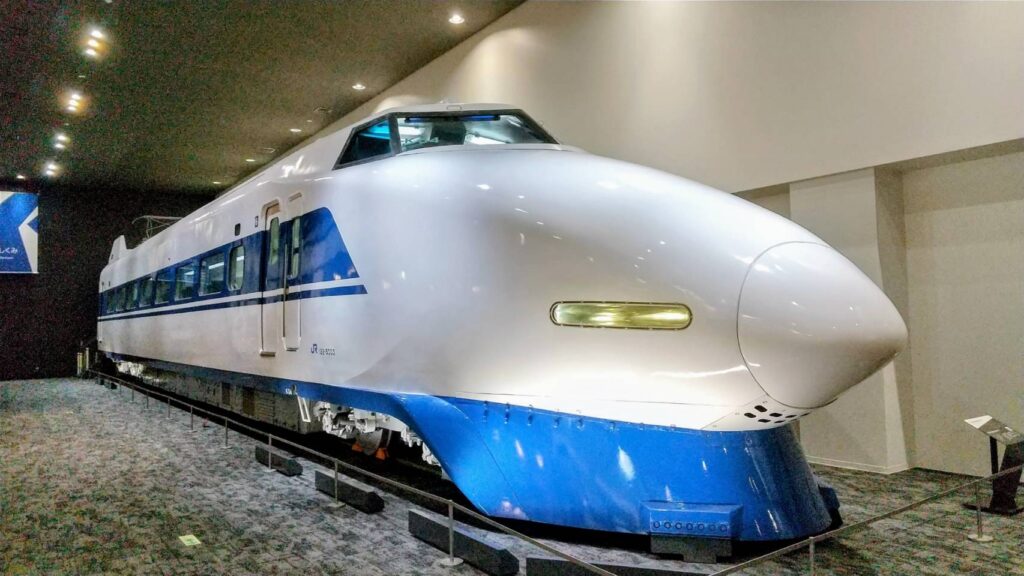
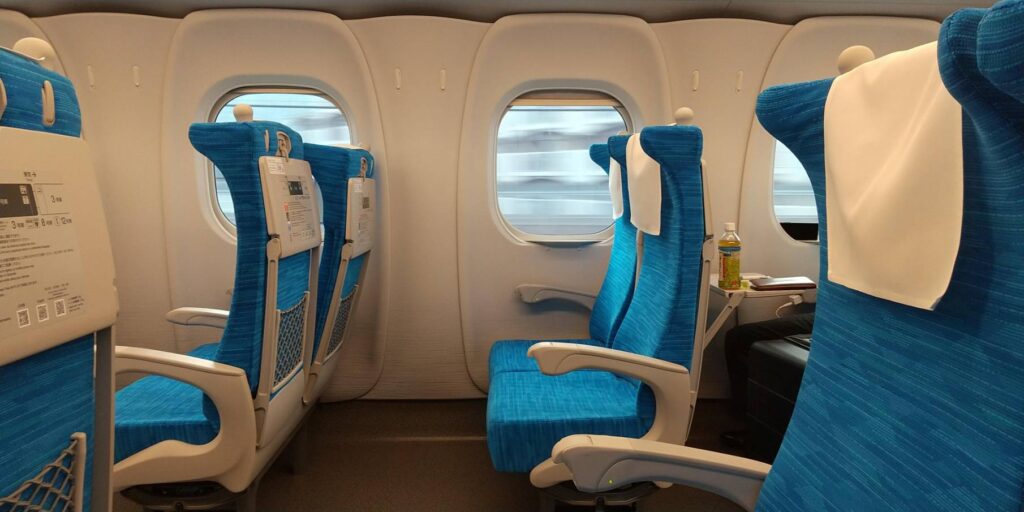
When the train arrives at the terminal, it must turn around for the next trip instantly. In just seven minutes, a cleaning crew (often wearing pink) sweeps through the cars, rotates all 1,300 seats, wipes the tables, and changes the linen. It is not just cleaning; it is theater. Watching them bow in unison at the end of their shift is a display of discipline that Harvard Business School has even studied.
6. The Last Days of “Dr. Yellow” & The Invisible Successors
For decades, the “Dr. Yellow”—a bright yellow test train—was a legend. Seeing it was considered a sign of immense good luck because its schedule was never public. We are now in the final chapter of this legend. While the JR Central version has already retired, the JR West version is scheduled to run until 2027. Seeing one now is rarer than ever—a true miracle. So, who checks the tracks now? The era of “Invisible Doctors” has begun. Select sets of the newest commercial trains (N700S) are now equipped with high-tech sensors. They inspect the tracks and overhead wires automatically while carrying you. The “Doctor” is no longer just a special yellow train; it is becoming part of the fleet itself.
7. Threading the Needle: The “Tokaido Megalopolis” & Tilting Tech
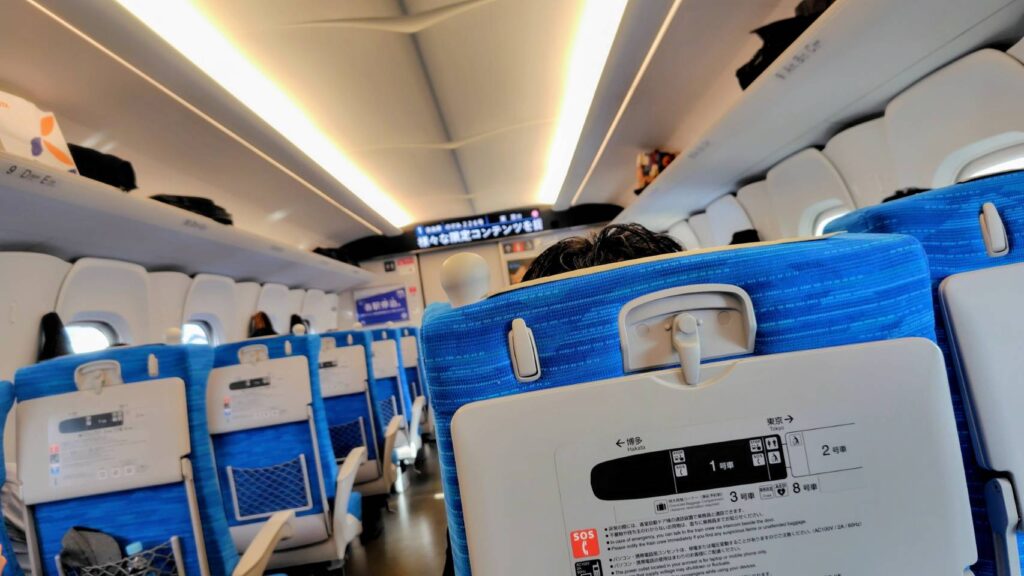
Why does the Tokaido Shinkansen have so many curves compared to high-speed trains in other countries? One reason is its age (built in 1964). But the real reason lies in Japan’s unique urban structure. Look out the window. You will notice that the buildings almost never end. This route runs through the “Tokaido Megalopolis,” a continuous belt of dense cities connecting Tokyo, Nagoya, and Osaka. Unlike the TGV in France which cuts through empty farmland, the Shinkansen must thread the needle through populated areas to serve the people. Because it weaves through these cities, curves were unavoidable. To conquer this, the latest N700S series uses air springs to tilt the train body by 1 degree inward—like a motorcyclist leaning into a turn. This technology allows the train to maintain 285 km/h while stitching together the world’s busiest urban corridor.
8. The Battle Against Snow (Sprinklers)
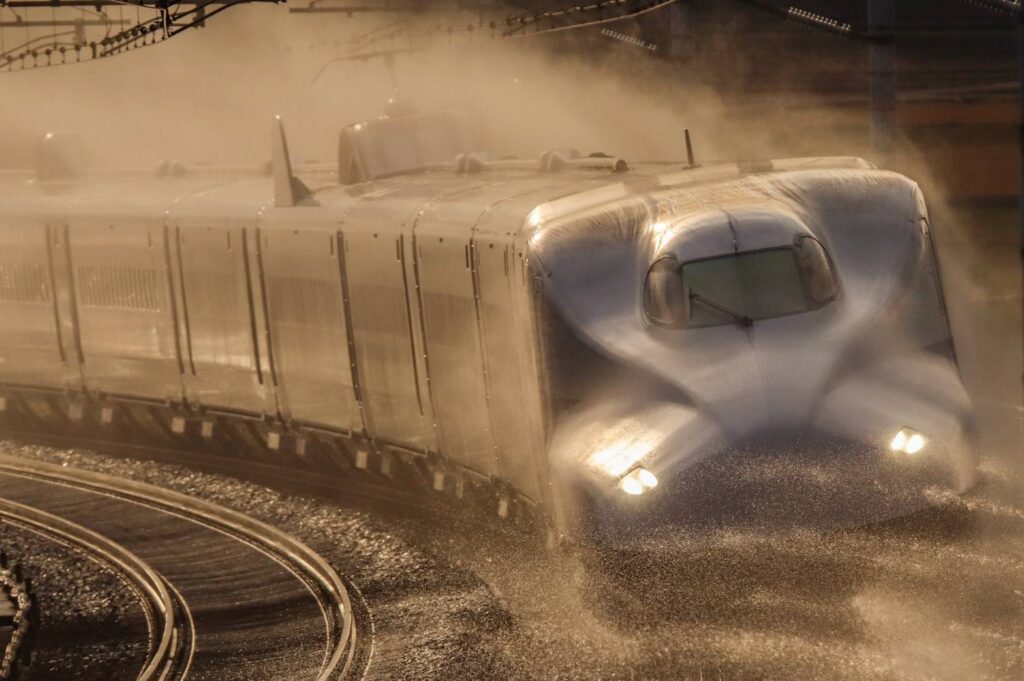
Between Maibara and Kyoto, the train passes through Sekigahara, an area famous for heavy snow. Snow buildup can derail high-speed trains. Instead of slowing down, the engineers installed thousands of sprinklers along the tracks to spray hot water and melt the snow instantly. If you look out the window in winter and see fountains of water, you are witnessing the infrastructure fighting nature to keep you on time.
9. The Chime Tells You Who Owns the Train
Listen carefully to the melody that plays before announcements. It tells you which company operates your train.
- JR Central vehicles (Tokyo side): You will hear a song called “Ai ni Iko” (Let’s Go Meet). It’s an uplifting tune representing the joy of meeting people.
- JR West vehicles (Osaka side): You will hear “Ii Hi Tabidachi” (Good Day for Travel), a classic Japanese ballad. Pro Tip: On JR West trains, listen closely. The melody is slightly different depending on whether the train is arriving at a terminal station or just a stop along the way. It is a subtle detail that only true rail fans notice.
10. The Unbroken Record: Zero Fatal Accidents
This is perhaps the most astonishing fact of all. Since the Tokaido Shinkansen opened in 1964, carrying over 10 billion passengers, there have been zero passenger fatalities caused by train accidents such as derailments or collisions. Even in a country prone to earthquakes, the record stands. The system is equipped with “UrEDAS” (Urgent Earthquake Detection and Alarm System), which detects tremors and cuts the power to the trains before the main shockwave hits. When you recline in your seat at 285 km/h, remember: you are sitting in statistically one of the safest places on Earth.
11. The Future is Floating (Maglev)
Finally, let’s look ahead. The Shinkansen as we know it might soon be “slow.” Japan is currently building the Chuo Shinkansen (SCMaglev). This train does not have wheels; it floats using superconducting magnets. It will connect Tokyo and Nagoya in 40 minutes at speeds of 500 km/h (310 mph). The history that began with a cigarette pack is now heading toward levitation.
Conclusion From the “Hi-Lite” tobacco inspiration to the automated high-tech inspections, the Shinkansen is a marvel of continuous evolution. Do you want to uncover more deep insights about traveling in Japan that guidebooks don’t teach you? [Join our Membership] to become part of our exclusive community and receive the latest updates on authentic Japan travel.


コメント